
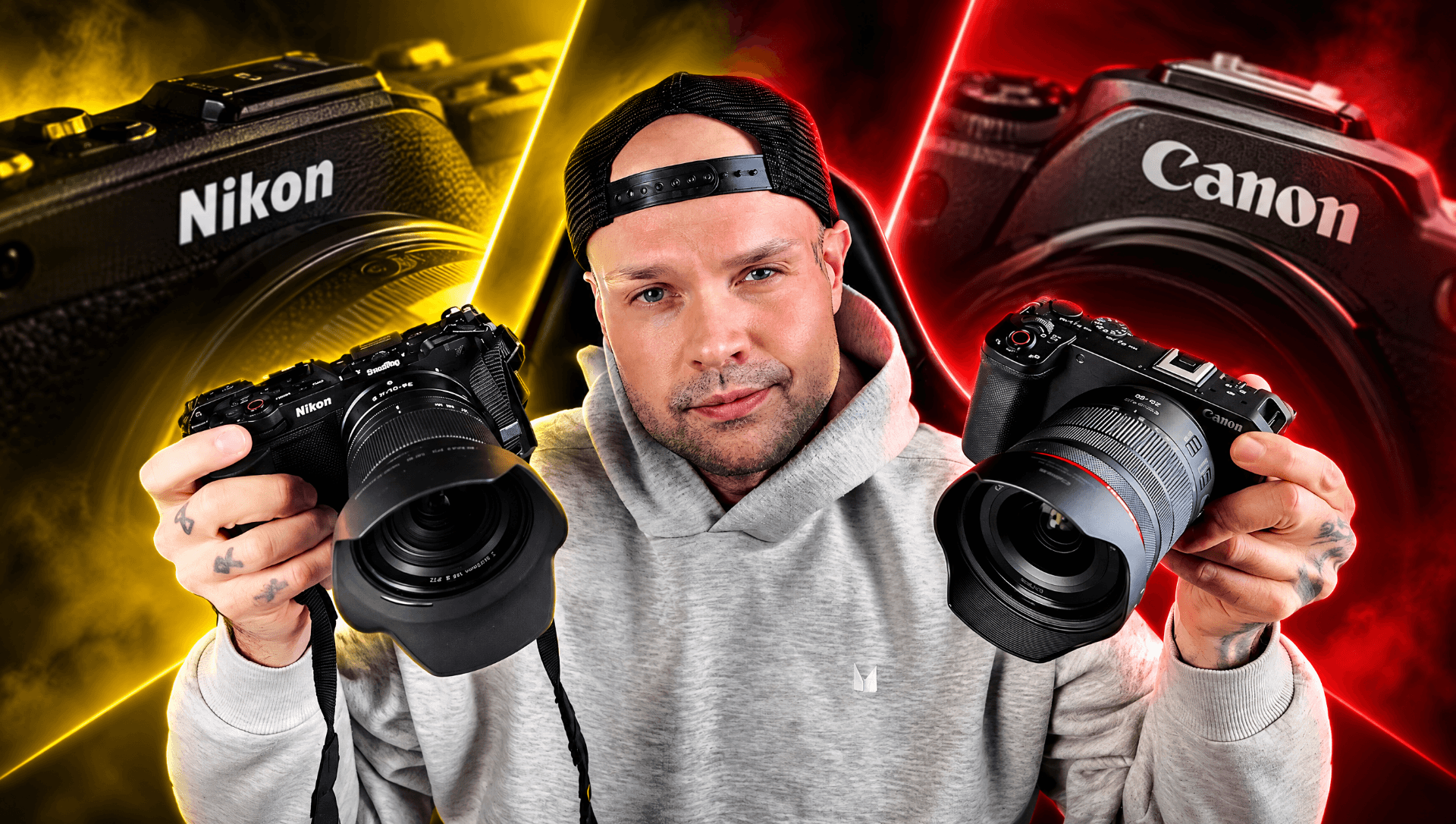
Canon R6V vs Nikon ZR: Mini Cinema Cameras Compared

Jere Alanen
admin
The world of content creation and filmmaking is evolving at an earth-shattering pace, and your gear shouldn't slow you down for a second. The new generation of "mini cinema cameras" answers exactly this need: mechanical shutters and traditional viewfinders have been stripped away for uncompromising video-centricity, and new AI features are starting to become part of the cameras.
Usually, these bodies are buried under massive rigs, external monitors, and matte boxes. I’ve owned the Nikon ZR since its release, and for this comparison, I received the Canon R6 V equipped with its kit lens. It was only natural to conduct this comparison right out of the box using just the kit lenses. The only exception was the cage added around the Nikon, because its new cinema-camera design is so petite that holding it with larger hands feels quite awkward without added grip. The Canon, on the other hand, fit naturally in the hand right away, thanks to a design that more closely resembles a standard mirrorless camera. Points to Canon for this.
But the real question is: which of these is genuinely the better tool for content creators and filmmakers?
Screen, Connectivity, and Sensor Speed
In fast-paced production, work cannot stall due to poor connectivity or cumbersome memory card slots. When cameras are stripped down to the essentials, everyday interfaces become crucial.
- Screen: Since neither camera features a traditional viewfinder, the rear screen’s importance is magnified. The Nikon ZR holds a real trump card here: its exceptionally large 4-inch, 1000-nit display is in a league of its own out in the field. It’s much easier to read in direct sunlight compared to Canon’s standard 3-inch screen, reducing the need for an external monitor.
- Connectivity & Cards: The Canon R6 V takes the win by offering a full-size HDMI port and a standard SD card slot alongside the pro-level CFexpress Type B slot. Nikon ZR relies on a notoriously fragile micro-HDMI and a tiny microSD as a secondary slot. Furthermore, Nikon’s card slots are at the bottom next to the battery, whereas Canon’s are on the side of the body, saving you time and nerves on set.
- Sensor Speed: Nikon ZR evens the score with its partially stacked sensor, offering faster readouts. This minimizes rolling shutter in fast movements, making it an invaluable feature for filmmakers.
The Reality of the Edit Bay: Resolution vs. Storage
Just looking at megapixels doesn't tell the whole story. In post-production, file sizes, cropping options, and workflow speed are what really matter.
- Canon R6 V: The camera is powered by a 32.5-megapixel full-frame sensor capable of stunning 7K RAW recording and the 3:2 Open Gate recording that is vital for content creators. Open Gate allows you to easily crop a horizontal video for YouTube and a vertical one for TikTok from the exact same clip without losing quality. Using the lighter H.265 codec still yields excellent 4K quality, keeping file sizes small and social media workflows smooth.
- Nikon ZR: The 24.5-megapixel sensor maxes out at 6K RAW and lacks Open Gate (for now). When compressing to H.265, Nikon is limited to 4K, and its quality trails behind Canon’s. To get the most out of the Nikon’s cinematic potential, you practically need to rely on the heavier RAW formats.
Cinematic Depth: RED’s Magic or Canon’s Workability?
The Nikon ZR carries the legacy of RED, directly visible in its color science and pro-level RAW workflow. In natural light, the differences were minimal; Canon’s C-Log 2 requires slightly more effort in post, but the final result is nearly identical to Nikon’s. However, under studio lighting, Nikon’s (RED’s) colors truly come alive: tones are richer and deeper, leaving Canon looking a bit flatter in comparison.
"Run and Gun" Operation: Audio, Image, and Stabilization
The Nikon ZR offers something extraordinary: 32-bit float audio recording, allowing you to salvage clipped audio perfectly in post. However, Canon’s standard 24-bit audio is extremely high quality as long as you set your levels correctly.
When operating "run and gun," the Canon R6 V takes a decisive lead in reliability. In layered shots (like filming yourself with trees in the foreground), Nikon’s continuous autofocus occasionally got confused, while Canon kept focus strictly on the subject. Canon’s image stabilization also performed better in my tests, keeping motion smooth and organic without a gimbal, and its active cooling ensures it won't overheat during long shoots.
What About Photography?
In a quick photography test under identical settings, Canon’s 32.5 MP sensor offered slightly more detail, but Nikon was only a hair behind. The most interesting observation was the tones: Nikon leaned slightly towards teal, while Canon appeared a bit more natural straight out of the camera. Both produce beautiful, easily editable images.
The Verdict: Canon R6 V or Nikon ZR?
Choosing between these two isn't about which one is universally better.
If you are a vlogger or desperately need Open Gate, superior built-in ergonomics, and rock-solid autofocus, the Canon R6 V is your ultimate workhorse. Its professional ports, high-quality H.265 compression, and unbeatable stabilization justify the higher price tag.
But if you shoot short films, want the life-saving 32-bit float audio, the incredible RED workflow, and a faster sensor, the Nikon ZR is literally a mini cinema camera in an unbelievable package. It’s an amazing deal at its price point, provided you don't mind using a cage for better ergonomics.
About the Author: Jeyshoots (Jere) is a photographer, filmmaker, and versatile creative professional based in Turku, Finland. His style is characterized by a strong cinematic look and narrative depth. He has been responsible for numerous fast-paced video and content productions in both sports and live music.
Want this look with one click?
I have packaged my workflow and color grading into professional-grade LUTs and Presets, optimized specifically for Sony S-Log3.
Browse Presets →

Discussion (0)
Ladataan kommentteja...